
Models and eco-system
Cashier model
A Cashier Instance is created by a server-to-server call when the customer navigates to deposit or withdraw funds, and the customer is then shown the Cashier Instance by loading within an iFrame.
Specific details on the Cashier Instance (such as payment methods available, pre-selected accounts, etc) are driven by a combination of:
Merchant configuration setup during onboarding with BR-DGE
Attributes provided by the merchant during creation of the Cashier Instance
Customer details of previous usage
The customer then interacts with the Cashier Instance and selects to begin a Transaction. The Transaction may be successful, in which case the Cashier Instance completes with a successful Transaction. Alternatively the Transaction may fail with a non-retryable failure, in which case the Cashier Instance typically completes with a failed Transaction. Or the Transaction may fail with a retryable failure, in which case the Cashier Instance is left active and the customer can try again.
Customer model
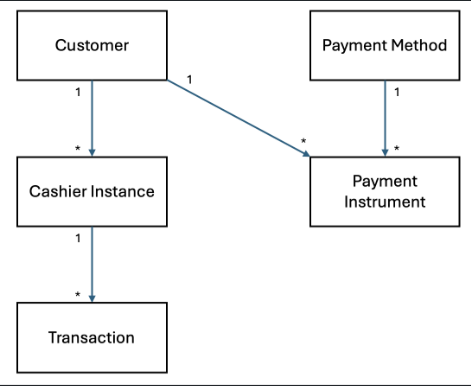
A customer can be related to multiple Cashier Instances, each Cashier Instance is related typically to a single Transaction, but may have multiple in case of failures, and so each customer is related to multiple Transactions.
Customers can have multiple Payment Instruments - with each Payment Instrument belonging to a Payment Method.
Merchant configuration may restrict this further, with some Payment Methods restricted such that a customer can have only a single Payment Instrument on that Payment Method; while other Payment Methods may allow up to N Payment Instruments per customer; or a Payment Method may allow an unlimited number of Payment Instruments per customer.
Finally, merchant configuration may impose uniqueness on Payment Instruments in a Payment Mode - such that a Payment Instrument in use by one customer cannot be used by another customer.
Entity model
The cashier entity model is described in the following diagram:
Ecosystem
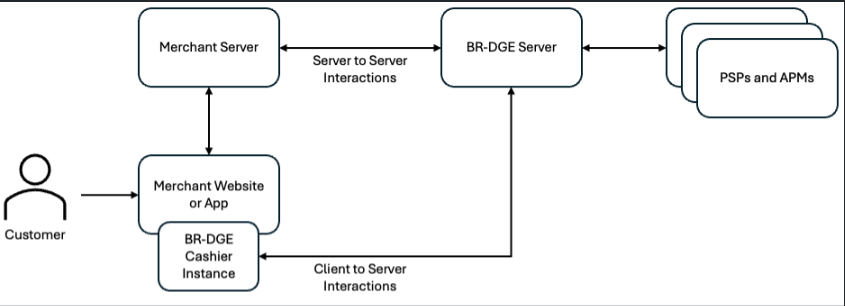
It is expected that a merchant server will make secure server-to-server calls to the BR-DGE service, passing any required information to the merchant website or app as necessary. The Cashier Instance is displayed in an iFrame on the merchant website or app, or as a full-page-redirect. The BR-DGE server typically interacts with PSPs and APMs on the merchant’s behalf, except as noted elsewhere in this guide.